



As a supplier of Traction Large Flow Pumps, I understand the critical importance of accurately measuring the performance of these essential pieces of equipment. Traction Large Flow Pumps are widely used in various industries, including construction, mining, and emergency drainage, where their ability to move large volumes of fluid efficiently is crucial. In this blog post, I will share some key methods and considerations for measuring the performance of a Traction Large Flow Pump.
1. Flow Rate Measurement
The flow rate is one of the most important performance indicators of a Traction Large Flow Pump. It refers to the volume of fluid that the pump can move in a given period. There are several methods to measure the flow rate:
Volumetric Method
This method involves collecting the fluid pumped by the Traction Large Flow Pump into a container of known volume over a specific time interval. By dividing the volume of the container by the time taken to fill it, we can calculate the flow rate. For example, if a 10 - cubic - meter tank is filled in 5 minutes, the flow rate is (10\ m^{3}/5\ min = 2\ m^{3}/min). This method is relatively simple and direct but may not be practical for continuous long - term measurements.
Velocity - Area Method
In this approach, we measure the velocity of the fluid at a cross - section of the pipeline using a flow meter, such as an electromagnetic flow meter or a Doppler flow meter. The flow rate (Q) can then be calculated using the formula (Q = V\times A), where (V) is the average velocity of the fluid and (A) is the cross - sectional area of the pipeline. This method is more suitable for continuous measurements and can provide real - time flow rate data.
2. Head Measurement
The head of a pump represents the energy per unit weight of the fluid that the pump adds to the fluid. It is a measure of the pump's ability to lift the fluid against gravity and overcome friction losses in the pipeline.
Static Head
The static head is the difference in elevation between the suction and discharge points of the pump. It can be measured using a level gauge or a surveying instrument. For example, if the fluid is being pumped from a well that is 5 meters below the ground level to a storage tank that is 10 meters above the ground level, the static head is (10+5 = 15) meters.
Friction Head
The friction head is the energy loss due to the friction between the fluid and the inner surface of the pipeline. It can be calculated using empirical formulas, such as the Darcy - Weisbach equation or the Hazen - Williams equation. These equations take into account factors such as the pipe diameter, length, roughness, and fluid velocity. In practice, the friction head can also be measured by comparing the pressure at two points along the pipeline and accounting for the elevation difference between these points.
The total head (H) of the pump is the sum of the static head and the friction head, (H=H_{s}+H_{f}), where (H_{s}) is the static head and (H_{f}) is the friction head.
3. Power Consumption Measurement
Measuring the power consumption of a Traction Large Flow Pump is essential to evaluate its energy efficiency. The power input to the pump can be measured using a power meter installed in the electrical circuit of the pump motor.
Shaft Power
The shaft power (P_{s}) is the power transmitted from the motor to the pump shaft. It can be calculated from the power input to the motor, taking into account the motor efficiency. The formula for shaft power is (P_{s}=\frac{P_{in}}{\eta_{m}}), where (P_{in}) is the power input to the motor and (\eta_{m}) is the motor efficiency.
Hydraulic Power
The hydraulic power (P_{h}) is the power that the pump actually imparts to the fluid. It can be calculated using the formula (P_{h}=\rho g QH), where (\rho) is the density of the fluid, (g) is the acceleration due to gravity, (Q) is the flow rate, and (H) is the total head.
The pump efficiency (\eta_{p}) can then be calculated as (\eta_{p}=\frac{P_{h}}{P_{s}}), which indicates how effectively the pump converts the input power into useful hydraulic power.
4. Cavitation Detection
Cavitation is a phenomenon that can significantly affect the performance and lifespan of a Traction Large Flow Pump. It occurs when the pressure of the fluid at the suction side of the pump drops below the vapor pressure of the fluid, causing the formation of vapor bubbles. When these bubbles collapse, they can cause damage to the pump impeller and other components.
Visual Inspection
One way to detect cavitation is through visual inspection. Cavitation often leaves visible signs of erosion on the pump impeller and other internal surfaces. By periodically disassembling the pump and examining these components, we can identify the presence and severity of cavitation.
Noise and Vibration Monitoring
Cavitation is also accompanied by increased noise and vibration levels. By installing vibration sensors and noise detectors on the pump, we can monitor these parameters in real - time. An increase in noise and vibration may indicate the onset of cavitation, allowing us to take corrective measures before significant damage occurs.
5. Applications and Considerations
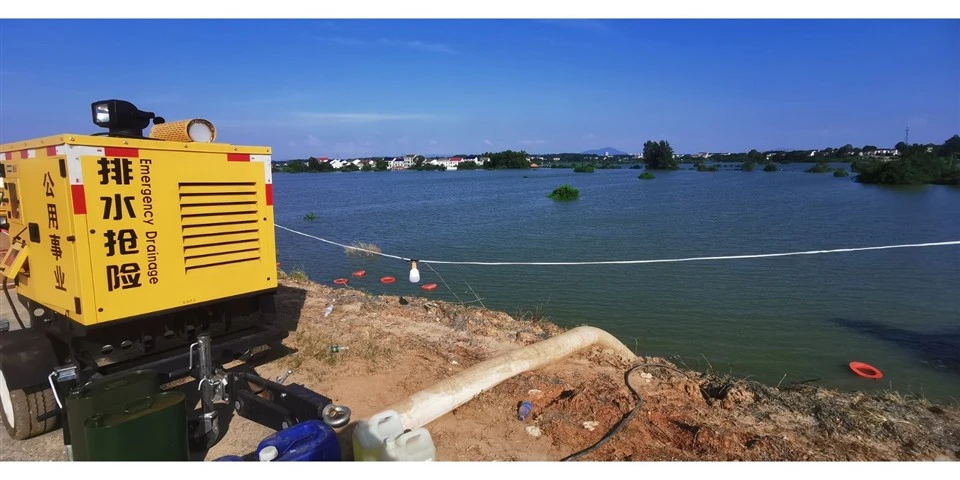
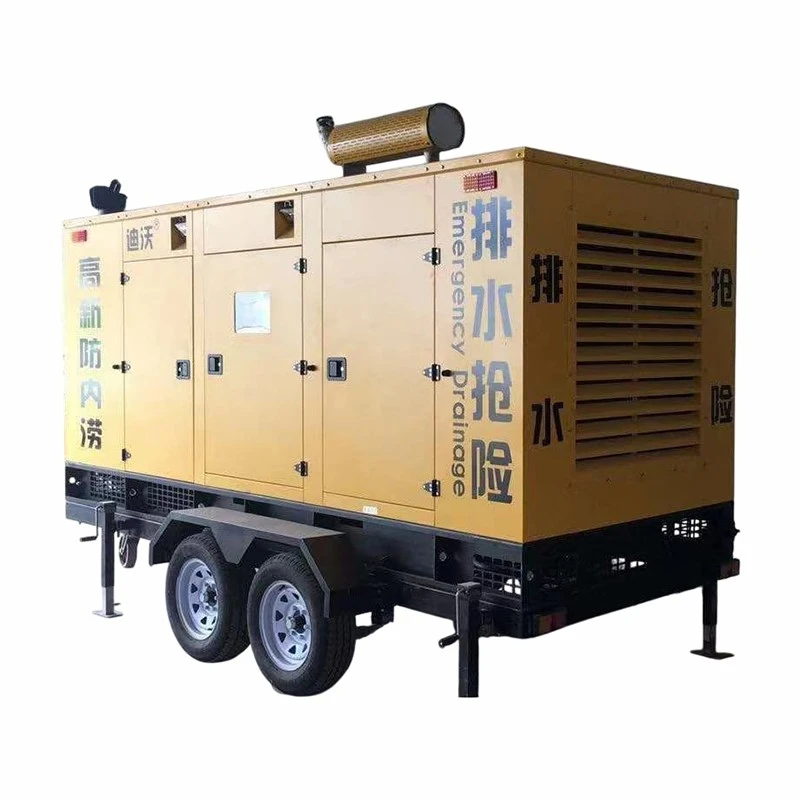
Traction Large Flow Pumps have a wide range of applications, such as in Mobile Pump Station On Wheels for emergency flood control and Underground Narrow Space Drainage. When measuring the performance of these pumps in different applications, we need to consider the specific requirements and conditions of each application.
For example, in emergency drainage applications, the pump needs to be able to start quickly and operate at high flow rates for a relatively short period. In such cases, the focus may be on measuring the pump's ability to reach the required flow rate rapidly and its short - term performance stability.
In long - term industrial applications, such as continuous fluid transfer in a mining operation, the emphasis may be on the pump's energy efficiency and long - term reliability. Regular performance measurements can help us identify any degradation in performance over time and schedule maintenance and repairs in a timely manner.
6. Contact for Purchase and Consultation
If you are interested in our Traction Large Flow Pump or have any questions about pump performance measurement, please feel free to contact us. Our team of experts is ready to provide you with detailed product information, technical support, and assistance in choosing the right pump for your specific application.
References
- "Pump Handbook" by Igor J. Karassik, Joseph P. Messina, Paul Cooper, and Charles C. Heald.
- "Fluid Mechanics" by Frank M. White.
- Industry standards and guidelines related to pump performance measurement.