


Hey there! As a supplier of Mobile Pump Stations, I often get asked, "What is the head of a mobile pump station?" Well, let's dive right into it.
First off, the head of a mobile pump station is a super important concept. In simple terms, it refers to the height to which a pump can lift water or the pressure it can generate. It's kind of like how high you can throw a ball - the higher you can throw it, the more "head" you've got in a way.
There are different types of head we need to talk about. The first one is the static head. This is the vertical distance between the water source and the point where the water is being discharged. For example, if you're pumping water from a well that's 10 meters deep and you're discharging it at ground level, the static head is 10 meters. It's just a straight - up measurement of the height difference.
Then there's the friction head. When water flows through pipes, hoses, or other components of the pump system, it encounters resistance. This resistance is like a little tug on the water, slowing it down and reducing the pump's ability to lift the water as high. The friction head accounts for this loss of energy due to friction. It depends on a bunch of things like the diameter of the pipes, the length of the pipes, and the roughness of the pipe walls. A smaller - diameter pipe will generally have a higher friction head because there's less space for the water to flow, causing more rubbing against the walls.
Another type is the velocity head. This is related to the speed of the water. When water is moving, it has kinetic energy. The velocity head represents the amount of energy associated with the water's motion. If the water is flowing really fast, it has a higher velocity head.
So, why does all this matter for a mobile pump station? Well, understanding the head is crucial for choosing the right pump. If you're dealing with a high - static head situation, like pumping water up to the top of a tall building, you need a pump that can generate enough pressure to overcome that height. Otherwise, the water just won't make it up there.
Let's say you're in an emergency water rescue situation. You might be using a pump to quickly remove water from a flooded area. The Emergency Water Rescue Pickup from our product line is designed to handle these types of scenarios. You need to know the head requirements based on how high you need to pump the water out and the friction losses in the hoses you're using.
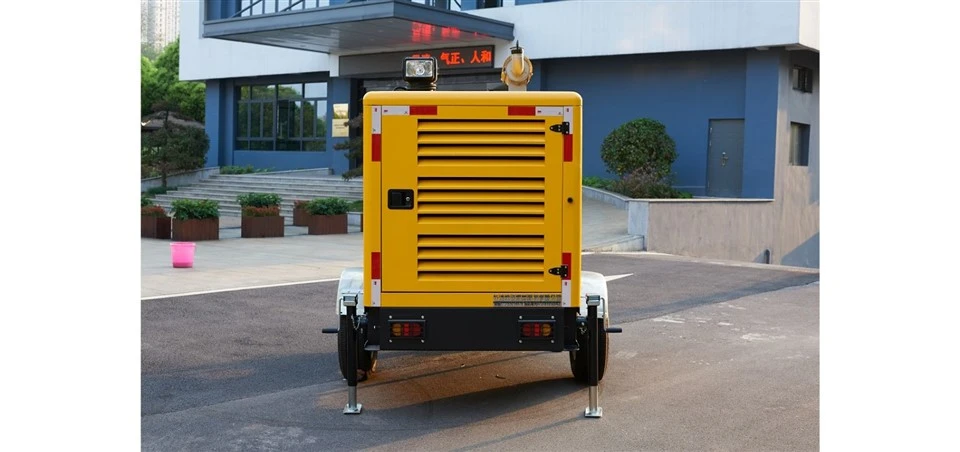
Similarly, for flood control, a Flood Control Mobile Pump Trailer can be a real lifesaver. You're likely dealing with large volumes of water and various distances and heights to pump it. If you underestimate the head requirements, the pump won't work as efficiently, and you might end up with water still lingering in the flooded area.
A Flooding Control Pickup is another option that's handy for smaller - scale flood control. It's important to calculate the head accurately so that you can make the most of this compact yet powerful tool.
When we're designing and manufacturing our mobile pump stations, we take all these head factors into account. We want to make sure that our pumps can handle different real - world situations. For example, we test our pumps with different pipe lengths and diameters to see how the friction head affects the performance. We also optimize the pump design to maximize the velocity head and overall efficiency.
Let's talk a bit more about how to calculate the total head. The total head is the sum of the static head, friction head, and velocity head. To calculate the static head, you just measure the vertical distance as I mentioned before. Calculating the friction head is a bit more complicated. There are formulas and tables available that take into account the pipe characteristics and the flow rate of the water. The velocity head can be calculated using the formula (V^2/2g), where (V) is the velocity of the water and (g) is the acceleration due to gravity.
In the field, it's not always easy to measure everything precisely. That's why we offer pumps with some flexibility. Our pumps are designed to have a bit of extra capacity to handle small variations in the head requirements. But it's still best to have a good estimate so that you can choose the most appropriate pump for the job.
Now, let's get into some practical tips for using a mobile pump station. When you're setting up the pump, make sure the pipes are as straight as possible. Bends in the pipes increase the friction head, reducing the pump's efficiency. Also, try to use the largest - diameter pipes that are practical for the situation. This will minimize the friction loss.
If you're working in an area with a lot of debris, make sure to use a strainer on the intake of the pump. Debris can clog the pump and disrupt the flow, affecting the head and the overall performance.
We've had some great feedback from our customers. One customer was using our pump in a flood - prone area. They were able to quickly set up the pump and start removing water. They were impressed with how well the pump performed, even with the high - friction hoses they had to use in the tight space. Another customer used our flood - control pickup in a small backyard flood. They said it was easy to operate and did the job perfectly, keeping their property dry.
So, if you're in the market for a mobile pump station, whether it's for emergency water rescue, flood control, or other applications, understanding the head is key. It helps you choose the right pump, set it up correctly, and get the best performance out of it.
If you're interested in learning more about our mobile pump stations or have specific head - related questions for your project, don't hesitate to reach out. We're here to help you make the right choice. Whether you're a contractor, a municipality, or an individual dealing with water - related problems, we've got a pump solution for you.
In conclusion, the head of a mobile pump station is a complex but essential concept. By taking the time to understand it, you can ensure that you're using your pump effectively and getting the most out of your investment. So, let's start a conversation about your pumping needs and find the perfect mobile pump station for you.
References

- Engineering textbooks on fluid mechanics
- Industry standards for pump performance testing