


Hey there! I'm a supplier of Water Drainage Pump Trucks, and today I wanna chat about how to calculate the power consumption of these bad boys. It's crucial info, whether you're looking to buy one or just curious about how they work.
First off, let's understand why power consumption matters. When you're using a water drainage pump truck, you're not only looking at the initial cost of the vehicle but also the long - term operational costs. Power consumption directly affects how much you'll be spending on fuel or electricity in the long run. So, getting a good handle on it can save you some serious cash.
The Basics of Power Consumption
Power consumption is all about how much energy a device uses over a certain period. For a water drainage pump truck, this energy is mainly used to run the pump, which moves water from one place to another. The unit of power is the watt (W), and we usually measure power consumption in kilowatt - hours (kWh).
Factors Affecting Power Consumption
- Pump Size and Capacity
The size and capacity of the pump play a huge role. A larger pump with a higher flow rate will generally consume more power. Think of it like a big engine in a car - it needs more fuel to run. For example, if you have a pump that can move 1000 cubic meters of water per hour, it'll use more power compared to a pump that can only move 500 cubic meters per hour. - Head Pressure
Head pressure is the height that the water needs to be pumped. The higher the head pressure, the more power the pump needs to overcome gravity and move the water. If you're pumping water up a tall building or over a long distance, the pump has to work harder, and that means more power consumption. - Efficiency of the Pump
Not all pumps are created equal. Some are more efficient than others. An efficient pump can do the same job using less power. When choosing a water drainage pump truck, look for pumps with high - efficiency ratings. This can make a big difference in your power bills over time. - Operating Conditions
The conditions under which the pump operates also matter. If the water is dirty or has a high viscosity, the pump has to work harder to move it. Similarly, if the pump is running continuously for long periods, it'll consume more power compared to intermittent use.
Calculating Power Consumption
Now, let's get into the nitty - gritty of calculating power consumption. The formula for calculating the power required by a pump is:
[P=\frac{\rho\times g\times Q\times H}{\eta}]
Where:
- (P) is the power in watts (W)
- (\rho) is the density of the fluid (for water, (\rho = 1000\ kg/m^{3}))
- (g) is the acceleration due to gravity ((g = 9.81\ m/s^{2}))
- (Q) is the flow rate in cubic meters per second ((m^{3}/s))
- (H) is the head pressure in meters (m)
- (\eta) is the efficiency of the pump
Let's break this down with an example. Suppose you have a pump with a flow rate (Q = 0.1\ m^{3}/s), a head pressure (H = 20\ m), and an efficiency (\eta= 0.8).
First, we calculate the numerator: (\rho\times g\times Q\times H=1000\times9.81\times0.1\times20 = 19620)
Then, we divide by the efficiency: (P=\frac{19620}{0.8}=24525\ W)
To convert this to kilowatts, we divide by 1000: (P = 24.525\ kW)
If the pump runs for 1 hour, the power consumption is (24.525\ kWh).
Real - World Considerations
In the real world, things are a bit more complicated. There are other factors like friction losses in the pipes, the power required to run the truck's engine (if it's a self - propelled pump truck), and any additional equipment on the truck.
Also, most pump trucks have variable speed drives, which means the power consumption can change depending on the actual operating conditions. For example, if the flow rate needs to be adjusted, the power consumption will change accordingly.
Our Water Drainage Pump Trucks
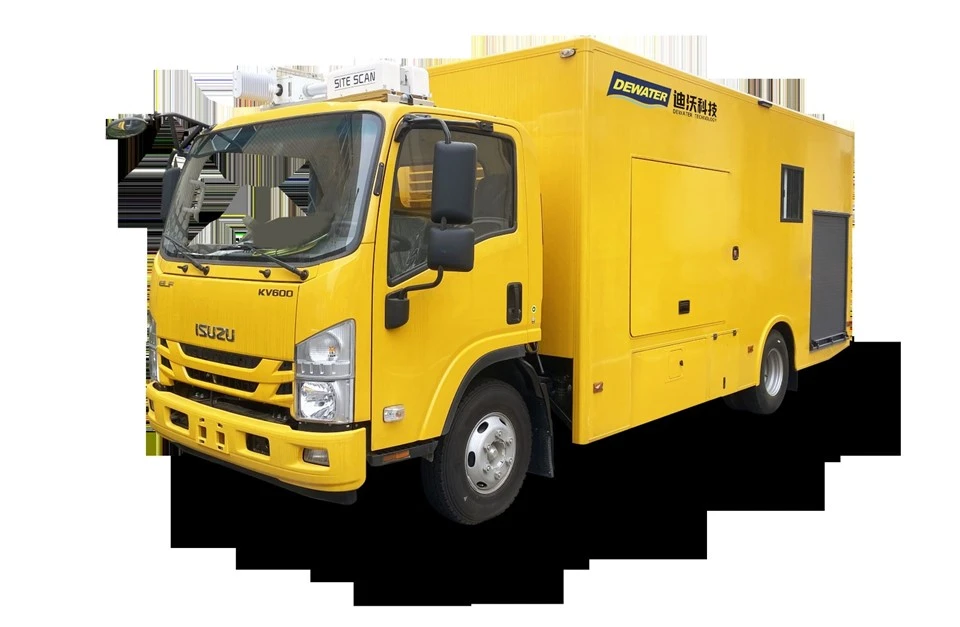
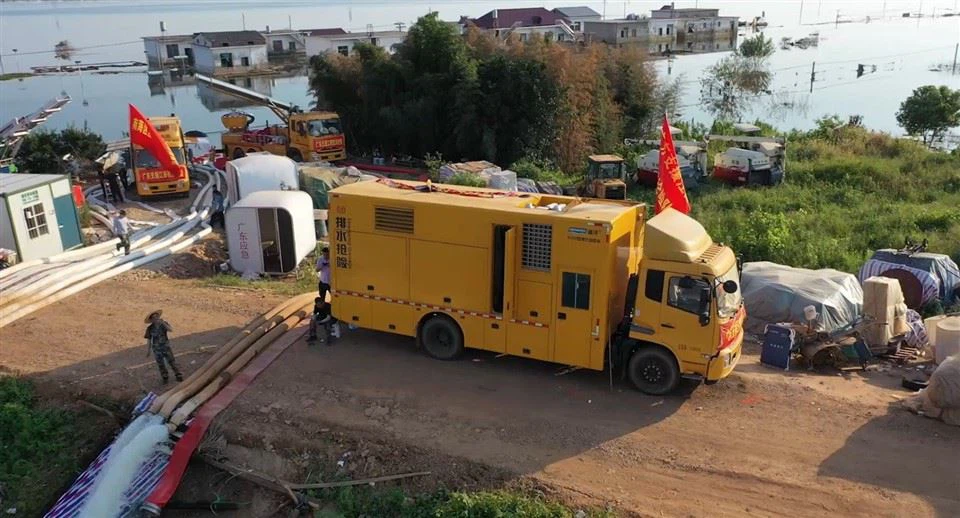
As a supplier, we offer a wide range of water drainage pump trucks, including Flooding and Dainage Pump Truck, Flood Control Pump Truck, and Drought Relief Drainage Pump Truck. Our trucks are designed with efficiency in mind. We use high - quality pumps with excellent efficiency ratings, and we offer different sizes and capacities to meet your specific needs.
When you choose our water drainage pump trucks, you can rest assured that you're getting a reliable and cost - effective solution. We can help you calculate the power consumption based on your requirements and provide you with all the information you need to make an informed decision.
Conclusion
Calculating the power consumption of a water drainage pump truck is an important step in understanding the overall cost of ownership. By considering factors like pump size, head pressure, efficiency, and operating conditions, you can get a good estimate of how much power your pump will use.
If you're in the market for a water drainage pump truck, don't hesitate to [contact us](here you would insert a real way to contact, but as per the rules, I'll just mention the concept). We're here to help you choose the right truck for your needs and answer any questions you may have about power consumption and other aspects.
References
- "Pump Handbook" by Igor Karassik et al.
- Industry standards and guidelines for water pump efficiency.