


As a supplier of water drainage pump trucks, I often get asked about the power - calculation formulas for these essential machines. Understanding these formulas is crucial for both selecting the right pump truck for a specific job and ensuring its efficient operation. In this blog post, I'll delve into the key power - calculation formulas for water drainage pump trucks, explaining the variables involved and how they impact the overall power requirements.
Basic Concepts of Power in Water Drainage Pump Trucks
Before we jump into the formulas, it's important to understand the basic concepts related to power in the context of water drainage pump trucks. Power, in this case, refers to the rate at which work is done to move water from one place to another. The work involves overcoming the resistance in the piping system, lifting the water to a certain height, and maintaining a specific flow rate.
The power required for a water drainage pump truck is influenced by several factors, including the flow rate (Q), the total head (H), the density of the fluid (ρ), and the efficiency of the pump (η).
Power - Calculation Formulas
1. Theoretical Power Formula
The theoretical power (Pth) required to pump water can be calculated using the following formula:
[P_{th}=\frac{\rho g Q H}{1000}]
where:
- (\rho) is the density of the fluid (for water, (\rho = 1000\ kg/m^{3}))
- (g) is the acceleration due to gravity ((g = 9.81\ m/s^{2}))
- (Q) is the flow rate of the pump, measured in (m^{3}/s)
- (H) is the total head, measured in meters
Let's break down the components of this formula:
- Flow Rate (Q): This represents the volume of water that the pump can move per unit of time. A higher flow rate means more water is being pumped, which generally requires more power. For example, if you need to drain a large flood - affected area quickly, you'll need a pump with a high flow rate.
- Total Head (H): The total head is the sum of the static head and the friction head. The static head is the vertical distance that the water needs to be lifted, while the friction head accounts for the energy losses due to the friction between the water and the pipes, valves, and other components in the system. A higher total head means more power is needed to overcome the resistance and lift the water to the desired height.
For instance, if you are pumping water from a basement to the ground level, the vertical distance between the basement and the ground is part of the static head. Additionally, if the pipes are long or have many bends, the friction head will be higher, increasing the total head and thus the power requirement.
2. Actual Power Formula
The actual power (Pact) that the pump motor needs to supply is higher than the theoretical power because no pump is 100% efficient. The efficiency ((\eta)) of a pump takes into account the losses due to mechanical friction, hydraulic losses, and other factors. The formula for the actual power is:
[P_{act}=\frac{P_{th}}{\eta}]
where (\eta) is the efficiency of the pump, expressed as a decimal. For example, if a pump has an efficiency of 80%, then (\eta = 0.8).
This formula shows that a lower - efficiency pump will require more power from the motor to achieve the same theoretical power output. When selecting a water drainage pump truck, it's important to consider the pump's efficiency to minimize energy consumption and operating costs.
Examples of Power Calculation
Let's assume we have a water drainage pump truck with the following parameters:

- Flow rate (Q = 0.1\ m^{3}/s)
- Total head (H = 20\ m)
- Pump efficiency (\eta= 0.8)
First, we calculate the theoretical power using the formula (P_{th}=\frac{\rho g Q H}{1000}). Substituting the values ((\rho = 1000\ kg/m^{3}), (g = 9.81\ m/s^{2}), (Q = 0.1\ m^{3}/s), and (H = 20\ m)):
[P_{th}=\frac{1000\times9.81\times0.1\times20}{1000}= 19.62\ kW]
Then, we calculate the actual power using the formula (P_{act}=\frac{P_{th}}{\eta}). Substituting (P_{th}=19.62\ kW) and (\eta = 0.8):
[P_{act}=\frac{19.62}{0.8}=24.525\ kW]
This means that the motor of the water drainage pump truck needs to supply approximately 24.525 kW of power to achieve the desired flow rate and total head.
Impact of Different Applications on Power Calculation
The power - calculation formulas are used differently depending on the application of the water drainage pump truck. Here are some common scenarios:
Flood Control
In flood - control situations, the main goal is to quickly remove large volumes of water from flooded areas. This requires pumps with high flow rates. For example, our Flood Control Mobile Pump Trailer is designed to handle high - volume water drainage. The power calculation in this case focuses on achieving a high flow rate with a relatively low total head, as the water is often being pumped to nearby low - lying areas or storm drains.
Flooding Control in Urban Areas
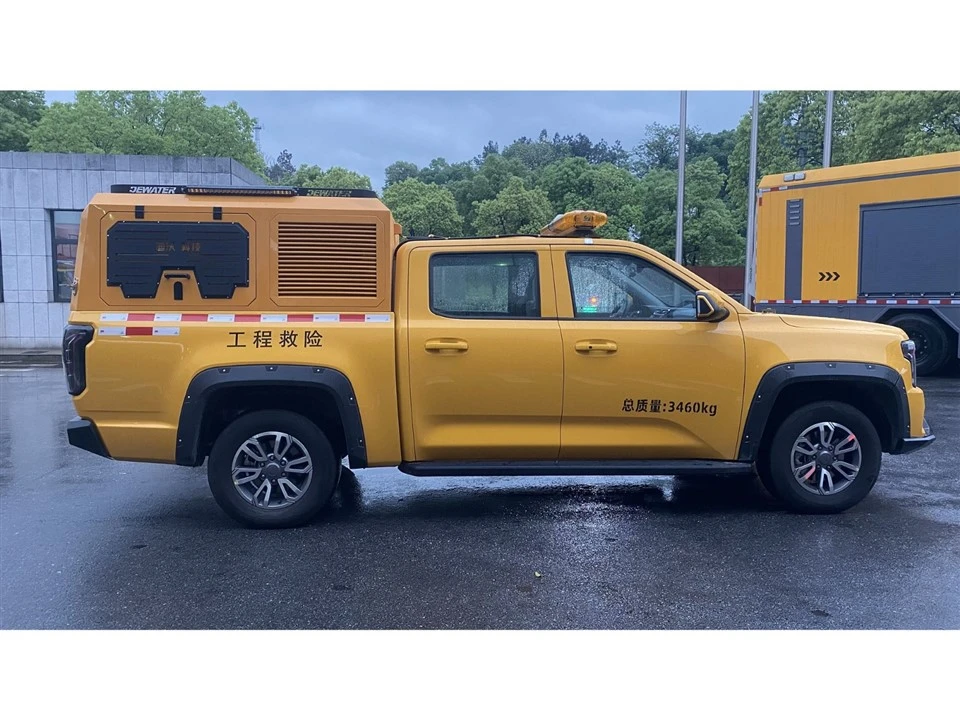
In urban areas, the situation can be more complex. There may be a need to pump water from basements or underground parking lots to the surface, which involves a higher total head. Our Flooding Control Pickup is suitable for such applications. The power calculation here needs to account for both the vertical lift and the friction losses in the pipes that are often installed in complex urban infrastructure.
Drainage in Disaster Sites
At disaster sites, such as after an earthquake or a hurricane, the water may be mixed with debris, which can affect the pump's performance. Our Drainage Pump Vehicles in Disaster Sites are built to handle such challenging conditions. The power calculation should consider the additional resistance caused by the debris and the need for a reliable and high - performance pump.
Conclusion and Call to Action
Understanding the power - calculation formulas for water drainage pump trucks is essential for making informed decisions when it comes to selecting the right equipment for your specific needs. Whether you are dealing with flood control, urban flooding, or drainage in disaster sites, accurate power calculations can help you ensure that the pump truck operates efficiently and effectively.
If you are in the market for a water drainage pump truck, our team of experts is here to assist you. We can help you calculate the power requirements based on your specific application and recommend the most suitable pump truck from our wide range of products. Contact us today to start the procurement process and find the perfect solution for your water - drainage needs.
References
- "Pump Handbook" by Igor J. Karassik et al.
- "Fluid Mechanics" by Frank M. White.