



The design of a pump impeller plays a pivotal role in determining the performance of a Mobile Flood Pump Trailer. As a supplier of Mobile Flood Pump Trailers, I have witnessed firsthand how different impeller designs can lead to significant variations in the efficiency, capacity, and overall effectiveness of these crucial pieces of equipment. In this blog, I will delve into the various aspects of pump impeller design and explain how they impact the performance of a Mobile Flood Pump Trailer.
1. Basic Concepts of Pump Impellers
A pump impeller is a rotating component within a pump that transfers energy to the fluid being pumped. It consists of a series of vanes or blades that are arranged around a central hub. When the impeller rotates, it creates a centrifugal force that pushes the fluid outward from the center of the impeller, increasing its velocity and pressure. This process is what allows the pump to move large volumes of water efficiently.
There are several types of impellers commonly used in Mobile Flood Pump Trailers, including open impellers, semi - open impellers, and closed impellers. Open impellers have vanes that are exposed on one side, making them suitable for handling fluids with large solid particles. Semi - open impellers have a shroud on one side of the vanes, providing better efficiency and wear resistance compared to open impellers. Closed impellers, on the other hand, have shrouds on both sides of the vanes, which offer the highest efficiency but are more prone to clogging when handling dirty water.
2. Impact of Impeller Design on Flow Rate
The flow rate of a Mobile Flood Pump Trailer refers to the volume of water that the pump can move per unit of time. The impeller design has a direct impact on the flow rate. The number, shape, and angle of the impeller vanes all contribute to determining how much water the impeller can push through the pump.
A larger number of vanes generally results in a higher flow rate. More vanes provide more surface area for the fluid to interact with, allowing the impeller to transfer more energy to the water. However, too many vanes can also increase the friction within the pump, reducing the overall efficiency.
The shape of the vanes is also crucial. Curved vanes are often used in impellers because they can smoothly guide the fluid through the impeller, minimizing turbulence and energy losses. The angle of the vanes relative to the direction of rotation also affects the flow rate. A steeper vane angle can increase the radial velocity of the fluid, leading to a higher flow rate, but it may also require more power to drive the impeller.
3. Influence on Head and Pressure
The head of a pump is the height to which the pump can lift the water. It is directly related to the pressure that the pump can generate. The impeller design significantly affects the head and pressure capabilities of a Mobile Flood Pump Trailer.
A well - designed impeller can convert the rotational energy of the motor into hydraulic energy effectively, resulting in a higher head. The diameter of the impeller is one of the key factors. A larger impeller diameter can generate a higher centrifugal force, which in turn increases the pressure and head of the pump.
The shape and curvature of the impeller vanes also play a role in determining the head. Vanes with a more gradual curvature can help to maintain a smooth flow of fluid, reducing the risk of cavitation (the formation and collapse of vapor bubbles in the fluid) and allowing the pump to operate at higher pressures.
4. Efficiency and Energy Consumption
Efficiency is a critical performance metric for Mobile Flood Pump Trailers. An efficient pump can move a large volume of water with less energy consumption, which is not only cost - effective but also environmentally friendly. The impeller design has a profound impact on the pump's efficiency.

As mentioned earlier, the type of impeller (open, semi - open, or closed) affects the efficiency. Closed impellers generally offer the highest efficiency because they minimize leakage and turbulence. However, they need to be carefully designed to prevent clogging.
The surface finish of the impeller vanes also matters. A smooth surface reduces friction between the fluid and the vanes, improving the efficiency. Additionally, the balance of the impeller is crucial. An unbalanced impeller can cause vibrations, which not only reduce the efficiency but also increase the wear and tear on the pump components, leading to premature failure.
5. Handling of Solid Particles
In flood situations, the water often contains a significant amount of solid particles such as sand, mud, and debris. The impeller design must be able to handle these solids without clogging or excessive wear.
Open and semi - open impellers are better suited for handling fluids with solid particles. The open structure allows the solids to pass through the impeller more easily. However, the design of the vanes still needs to be optimized to prevent the solids from getting stuck between the vanes. Some impellers are designed with wider vane spacing or special geometries to enhance the passage of solids.
6. Real - World Applications and Case Studies
In real - world flood control scenarios, the performance of Mobile Flood Pump Trailers can make a significant difference. For example, during a severe flood in a coastal city, a well - designed pump with an appropriate impeller can quickly drain large volumes of water from flooded areas, reducing the damage to property and infrastructure.
One of our customers, a local emergency management agency, used our Mobile Flood Pump Trailers equipped with semi - open impellers to handle floodwater with a high concentration of sand and debris. The pumps were able to operate continuously for several days without clogging, effectively draining the flooded streets and preventing further waterlogging.
7. The Role of Our Company in Providing Optimal Impeller Designs
As a supplier of Mobile Flood Pump Trailers, we understand the importance of impeller design in achieving optimal performance. Our engineering team conducts extensive research and development to design impellers that meet the specific needs of our customers.
We use advanced computational fluid dynamics (CFD) simulations to analyze the flow patterns within the impellers and optimize their designs. This allows us to improve the efficiency, flow rate, and head of our pumps while ensuring that they can handle solid particles effectively.
8. Related Products and Their Features
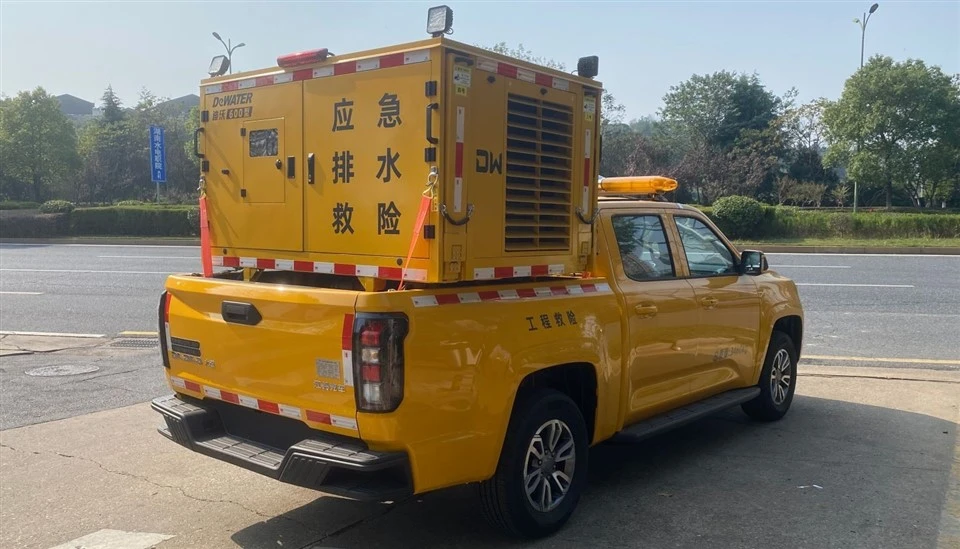
We also offer a range of related products, such as the Flooding and Dainage Pump Truck, Mobile Pump Station, and Mobile Fire Water Supply Pump Trailer. These products are designed with similar attention to impeller design to ensure high - performance operation.
The Flooding and Dainage Pump Truck is a versatile vehicle that can quickly be deployed to flood - affected areas. It is equipped with a powerful pump and an optimized impeller to handle large volumes of water. The Mobile Pump Station is a more stationary solution that can be set up in strategic locations to provide continuous drainage. It features a robust impeller design that can withstand harsh operating conditions. The Mobile Fire Water Supply Pump Trailer is designed for fire - fighting applications, with an impeller that can generate high pressure to deliver water over long distances.
9. Conclusion and Call to Action
In conclusion, the pump impeller design is a critical factor that affects the performance of a Mobile Flood Pump Trailer in terms of flow rate, head, efficiency, and the ability to handle solid particles. Our company is committed to providing high - quality Mobile Flood Pump Trailers with optimized impeller designs to meet the diverse needs of our customers.
If you are in the market for a reliable Mobile Flood Pump Trailer or any of our related products, we invite you to contact us for a detailed discussion. Our team of experts is ready to assist you in selecting the right equipment for your specific requirements. Whether you are dealing with flood control, fire - fighting, or other water - related applications, we have the solutions to meet your needs.
References
- Stepanoff, A. J. (1957). Centrifugal and Axial Flow Pumps: Theory, Design, and Application. John Wiley & Sons.
- Karassik, I. J., Messina, J. P., Cooper, P. T., & Heald, C. C. (2008). Pump Handbook. McGraw - Hill.
- Gulich, J. F. (2010). Centrifugal Pumps. Springer.